Rock Hoppers

A House Against the Dark

A family crew. A worked ship. A claim beyond the reliable charts.

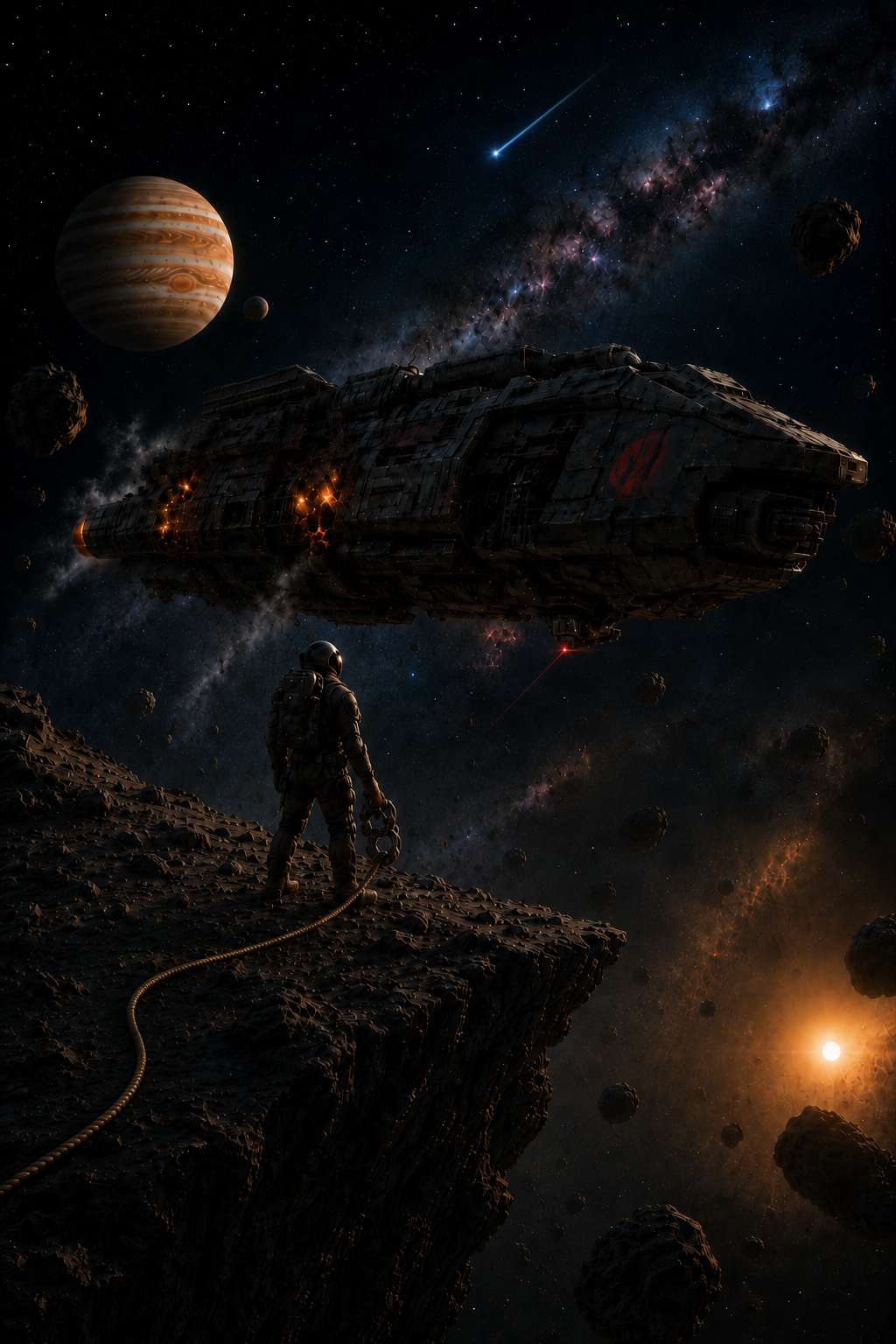
Rock Hoppers: A House Against the Dark — Bodhi on an asteroid beneath the Resolute, with Jupiter and the sun beyond

On Lily's exterior feed, he stood alone on the broken lip of the cap, a small dark figure beneath the pirate ship. The vessel filled the sky above him, patched armor catching thin strips of sunlight, guns and folded radiators cut black against the stars. Loose rocks turned through the distance around it. Far beyond, the long lens brought Jupiter's striped face close enough to seem part of the field, while the sun burned low past the asteroid's rim. For one second the whole scene held still: the old man, the black rock, the armed ship waiting overhead. Then the asteroid carried him toward the launch line.

A World With a Long Memory

Aurora is orderly, enclosed and watched over by systems that usually work.

Beyond it, distance changes the rules. Help may be days away. A claim begins with physical work and a name placed beside the record. Old ships carry families between scattered settlements, and old customs often matter more than instructions issued from somewhere too far away to help.

When Lily and Gavin Volkov leave home to join their grandparents aboard the Resolute, they expect to learn the family trade. They find out how much that trade asks of the people who practice it.

Nothing in the Volkovs' world feels newly made.

Ships are repaired until their patches become part of the design. Claims pass through families. Laws are quoted in fragments by people who cannot always name their source. Household machines remember births, arguments and childhood habits long after the humans involved are gone.

The past is present everywhere, though much of it has become difficult to read.

People still rely on inherited institutions, inherited tools and inherited obligations. They know these things survived for a reason.

They do not always know what the reason was.

A Family Frontier Story

Lily and Gavin have grown up protected by schedules, schools, pressure doors and adults who could usually summon help.

Life aboard the Resolute is different. Water is counted. Equipment is checked twice. Every person has work, including the children. A mistake made outside the hull may not leave time for anyone else to correct it.

Their grandparents, Bodhi and Elara, have spent decades living that way. They love their family through preparation, training, repairs and the occasional argument over whether Bodhi's latest solution should legally qualify as maintenance.

The Volkovs disagree about danger, authority, history and what children should be allowed to see.

They still have to work the same problem together.

The Rescue

Elara rotated the Resolute's approach. "I can put you fifty meters off his port quarter."

"Cargo line?"

"Midship reel is good."

"Give me the end of it."

Bodhi released his harness and pushed toward the lock.

Vetch understood enough to swear. "Volkov, don't climb outside between an uncontrolled ship and a rock."

"I'm not planning to stand there."

"That distinction isn't comforting."

"Then stop listening."

The suit sealed around Bodhi with old familiarity. He clipped the Resolute's cargo line to his waist hardpoint, checked the manual release twice, and armed the tether unit built into his forearm.

The wrist line could save a man who had pushed wrong. A ship would tear it apart if the ship got any vote in the matter.

It only had to save the man.

Elara brought the Resolute alongside the Second Guess, matching the old ship's drift without matching its tumble. The hull rolled past Bodhi's viewport in sections: radiator, scarred cargo bay, faded registry stripe, ruptured tank shedding the last glittering remains of its propellant.

"Thirty meters," Elara said.

"Rotation?"

"Forty-seven seconds. Hardpoint faces you in twelve."

Bodhi opened the outer lock.

The rocks and the dark filled his visor. Stars, the Resolute under his boots, the Second Guess turning in front of him. Somewhere inside that wreck, one living man had run out of useful mistakes.

"Object contact in seventeen minutes," BASH said.

"I preferred your earlier mood."

"I have several."

The hardpoint came around.

Bodhi locked one boot beneath the outer rail and raised his arm.

"Firing."

The wrist tether crossed the dark. Its magnetic head struck the Second Guess half a meter below the hardpoint, skated a handspan across the plating, and clamped flat.

A green lock mark appeared inside Bodhi's visor.

The recoil drove through his shoulder and into the rail beneath his boot.

He pulled against the line.

The anchor held.

"Good connection," he said.

"Confirmed," Elara said. "Hardpoint is passing you now."

Bodhi released the rail and pushed.

The tether reel took up the slack and drew him across, controlling his approach while the Second Guess rolled beneath him. The Resolute's cargo line followed from his waist in a slow curve.

The hull came up fast.

He caught a handhold, let the wrist unit carry his weight, and waited for the tow hardpoint to pass under his glove. When it came, he clipped the cargo line into it and drove the manual lock home.

"Line attached."

"Come back."

He checked the distance, the turning hull, and the clock inside his visor.

"No time."

Elara's channel stayed open. Her breathing changed once and settled.

"Then stay clipped."

"Doing that."

"Contact in nine minutes," BASH said. "Required lateral velocity change is three-point-eight centimeters per second."

Small numbers killed people in space.

Elara edged the Resolute outward. The cargo line uncoiled between the ships. Bodhi clipped his suit directly to the Second Guess's hardpoint, released the wrist tether, and flattened himself against the hull.

"Line coming taut," Elara said.

The asteroid grew on his visor from a marker into a black wall.

The timing depended on the tumble. Pull too early and the line would wind across the hull. Pull late and the force would wrench the hardpoint sideways instead of shoving through the ship's center.

The Second Guess rolled.

The tow line crossed the right angle.

"Now," Bodhi said.

The Resolute's lateral thrusters fired.

The line struck straight. Metal complained under Bodhi's chest. The hardpoint held.

"Two centimeters per second," MIRA said.

The asteroid kept coming.

Elara fired again.

"Three-point-two."

"Again."

"Hardpoint load is approaching limit," BASH said.

"Again."

The Resolute fired.

Nothing on Bodhi's visor moved in a way a human eye could trust. The asteroid stayed ahead. The old ship kept sliding toward it. Space offered no wake, no skid mark, no proof of effort.

The collision marker crossed the numbers.

Negative eleven meters.

Negative four.

Zero.

Positive six.

Positive fourteen.

"Enough," Elara said.

The tow line went slack.

The asteroid passed less than twenty meters below the Second Guess.
What the Story Explores

What one generation leaves the next

The Volkov children inherit more than property. They inherit skills, family debts, unfinished arguments and stories whose meanings have changed in the telling. The adults have inherited the same things. They simply have less freedom to admit when they do not understand them.

Freedom with work attached

Beyond the settled routes, people possess a great deal of practical freedom. They also live with the results of their own preparation, judgment and reputation. A distant authority can certify a claim or issue a ruling. It cannot tighten a suit seal, answer a distress call or make the immediate decision.

Work, ownership and witness

A registry entry alone does not make a claim real. Someone must find the rock, place the markers, perform the survey, maintain the equipment and put a name beside the readings. Ownership grows out of work that other people can verify. That system is imperfect. It is also one of the few systems capable of surviving the distance.

Families and their machines

The machines aboard the Resolute navigate, teach, monitor, object and remember. Some are tools. Some have served beside the same people long enough that the distinction has become difficult to maintain. Their memories may preserve parts of a family's history more accurately than any living member can. Their restrictions may be just as old.

History after the records fail

Archives can lose context. Public stories can keep the shape of an event while changing its meaning. A useful rule may survive for centuries after its origin disappears. Rock Hoppers follows people who depend on those surviving pieces, even as they begin to notice the gaps between them.

Hard Science. Old Questions.

Rock Hoppers: A House Against the Dark is a frontier science-fiction novel grounded in orbital mechanics, pressure systems, resource limits, repair work and the practical difficulties of keeping human beings alive beyond a settled world.

Its ships require fuel, cooling, maintenance and judgment. Its machines operate within limits. Its characters survive through competence, cooperation and occasional luck.

The larger questions are older:

  • What makes ownership legitimate?
  • What does a person owe a stranger in danger?
  • When does a machine become part of a household?
  • How much risk should children be protected from, and what must they learn before protection is no longer available?
  • What happens when a civilization remembers its laws more clearly than its own beginning?

Rock Hoppers
A House Against the Dark